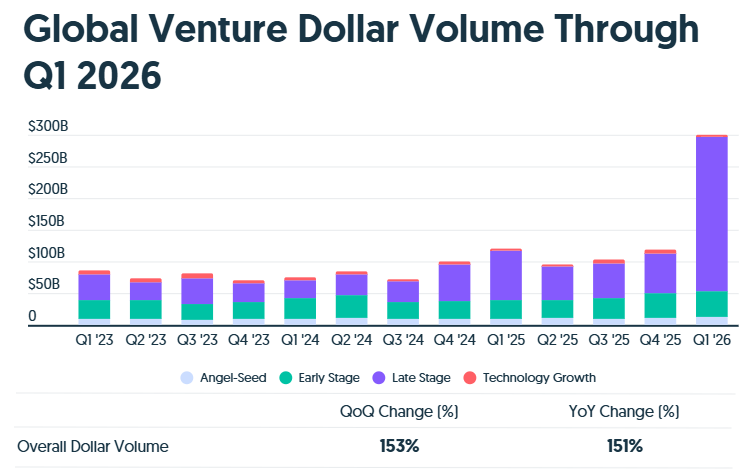
In the first quarter of 2026, the global venture capital market reached a historic turning point, characterized by an unprecedented concentration of capital within the Artificial Intelligence (AI) sector. According to the latest data from Crunchbase, total investment for the quarter surpassed $300 billion, marking an explosive growth of over 150% compared to the same period last year.
This surge reflects global capital's conviction in the disruptive potential of AI technology despite macroeconomic uncertainties, suggesting that the investment paradigm across the tech industry has been completely restructured around AI.
- Unprecedented Scale of Capital Concentration in AI
Out of the $300 billion in total venture funding this quarter, approximately 80% ($242 billion) flowed into the AI sector. This is a dramatic increase from a 55% share in the same period last year, indicating that AI is effectively monopolizing liquidity in the global capital market. Across the broader market, the valuation of unicorn companies rose by a total of $900 billion, marking the largest single-quarter increase in value in history.
- Market Dominance by a Select Few
While the total volume of investment skyrocketed, the distribution of capital remained extremely skewed. Roughly 65% of the total funding was concentrated in just four core AI entities: OpenAI, Anthropic, xAI, and Waymo. Notably, OpenAI solidified its dominant position by securing $122 billion, the largest single funding round in venture history. This concentration of capital among the "Big 4" is widening the technological and infrastructural gap between them and trailing competitors.
- Deepening Polarization by Investment Stage and Region
Late-stage investment reached $246.6 billion, soaring by more than 200% year-over-year, while early-stage investment showed relatively modest growth. This trend suggests a "flight to quality," where investors prefer deploying massive capital into established leaders with proven market dominance rather than high-risk startups. Geographically, North America maintained its hegemony by capturing 84% of the total capital, while the Asian market saw a slight rebound driven by hardware-focused investments in China.
- Shift in Strategic Investment Priorities
While previous investments focused on the broad possibilities of general-purpose models, capital is now shifting toward "Vertical AI" and enterprise workflow solutions capable of generating immediate revenue. Investors have begun to place greater weight on verifying revenue models and operational efficiency applicable to actual business processes, moving beyond mere technical benchmarks.
In conclusion, the first quarter of 2026 served as a definitive period proving that AI has moved beyond a mere tech trend to become a foundational industry of the global economy. However, the rapid concentration of capital into a handful of companies may lead to adverse effects, such as technological monopolies and heightened barriers to entry. The future health of the market now depends on whether this massive influx of capital can be converted into tangible economic performance and revenue.
Companies are now facing a rigorous test to prove not only their technical prowess but also their capital efficiency and practical market dominance.